
Please Don’t Call CPS, But I’ll Understand if You Do
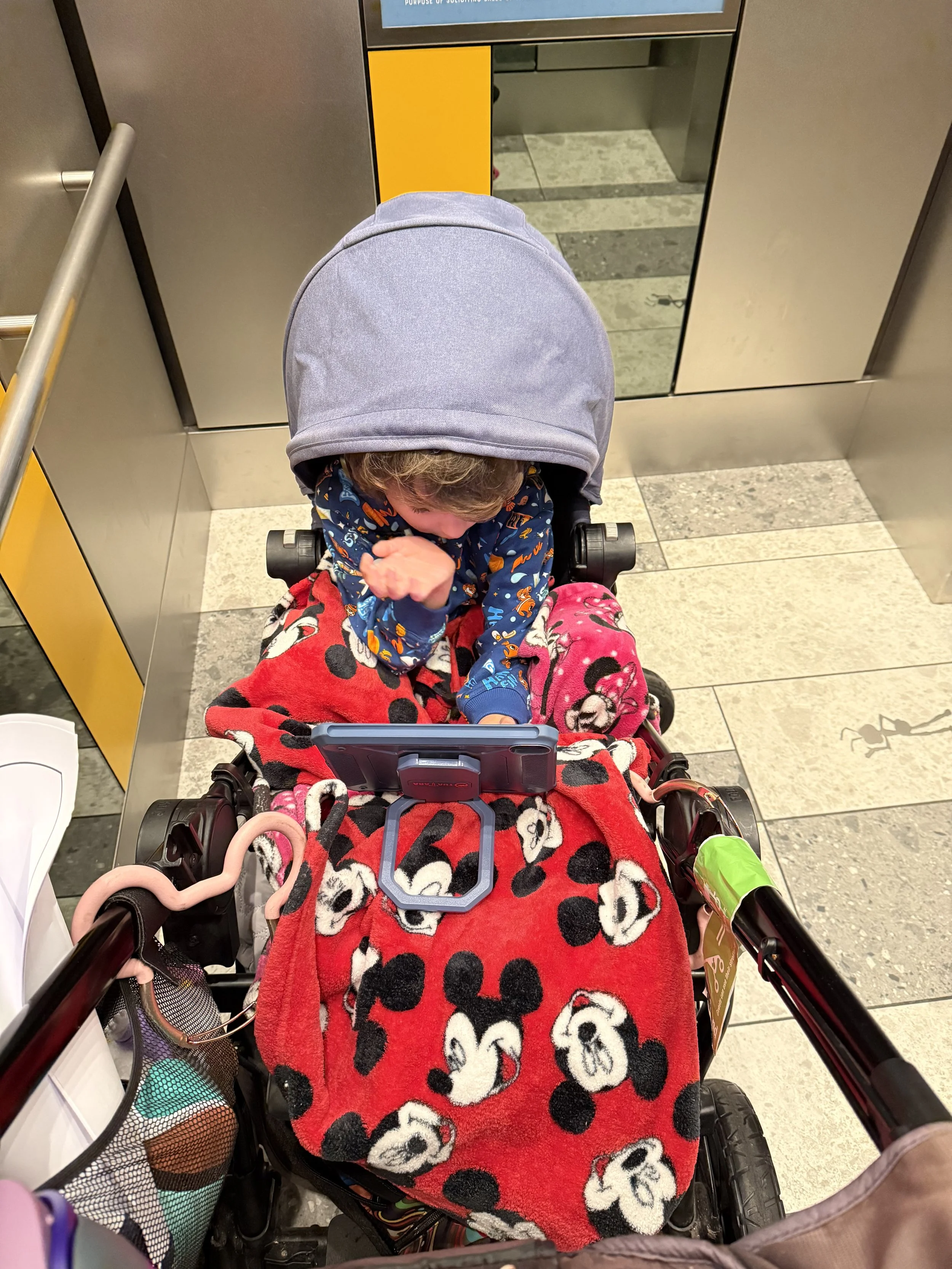
There are moments in parenting where you know, deep down, that what you’re doing is necessary, even if it looks questionable, uncomfortable, or downright alarming from the outside.
We’re in the middle of trying to wean my son off constant iPad use at home, and I want to be clear from the start: this is not an anti-technology story. We’ve been very open to letting him use his iPad, and intentionally so. Research has shown that for many autistic children, tablet use can support emotional regulation by providing predictable structure, visual engagement, and sensory modulation that helps calm an overwhelmed nervous system. For my son, that is absolutely true. He is genuinely his happiest when he’s on it.
For a long time, the iPad was something we reserved for restaurants, airplanes, or long waits, and it usually stayed out of our home routines.
Then life happened.
A few weeks ago, we were busy. And tired. And stretched thin. My son is in school all day, followed by 20 hours a week of ABA therapy. When he was home, the iPad worked. He was calm, content, regulated. Slowly, almost without us realizing it, the iPad became part of every unstructured moment of his day. Before long, it felt like every waking hour outside of school and therapy was iPad time.
That’s when we noticed the shift.
He started expecting it the moment he woke up, and it became the last thing he wanted before bed. Any denial, any pause, any “not right now”, was met with truly epic meltdowns. My husband and I talked and agreed we needed to pull back a bit, to reduce iPad use while we were at home. But almost immediately, it turned into an all-or-nothing battle. Any boundary at all felt unbearable to him.
Last weekend, as we were getting ready for a trip to Disneyland, that battle came to a head. I was trying to pack, mentally juggling a hundred things, while my son followed me from room to room with his headphones on and his iPad in his hands, asking me to unlock it over and over again. He took my hand and gently placed it on the screen. He looked up at me with his sweet face. He asked appropriately. And when I said, “Not right now, buddy,” he screamed. This cycle repeated no fewer than a hundred times. Eventually, I broke. I handed him the iPad. Not because it was the right decision, but because I needed to finish packing in peace.
On the drive down, my husband and I made a decision: cold turkey. No iPad at home.
The last few mornings have been brutal. “iPad” is one of the first words out of his mouth when he wakes up, sometimes as early as 4 a.m., thanks to sleep challenges related to autism. The screaming starts almost immediately and doesn’t stop until we’re in the car on the way to school.
Which brings me at long last to my point.
I know my neighbors can hear him. I know they can hear me. And during those few minutes when we’re transitioning from the house to the car, when his meltdown is usually at its peak, I’m painfully aware that the entire neighborhood can hear it too.
At some point, probably sooner rather than later, Child Protective Services may knock on my door.
And if I’m being completely honest, I understand why.
Child Protective Services exists for a reason, and it is a critical one. They protect children who truly are being harmed, neglected, or abused. They step in when children cannot advocate for themselves. Their work saves lives. Full stop. I never want to live in a world where people don’t speak up when they believe a child may be in danger.
What many people don’t realize, though, is that caregivers of children with disabilities, especially children with autism, are disproportionately familiar with CPS visits. Not because we are abusive parents, but because disability can be loud. It can be chaotic. It can look alarming to someone who doesn’t understand what they’re seeing.
I’ve had countless families tell me about CPS visits that followed an unexpected elopement from the house. A neighbor saw a child running down the street barefoot and panicked. I’ve heard about calls after very public meltdowns, after aggressive behaviors, after a child resisted getting into a car. In nearly every case, once CPS understood the context, once they saw the therapy schedules, the safety plans, the exhausted but attentive parents, the case was closed. The visit ended not with punishment, but with understanding.
When this happens, my coaching is always the same: they are doing their job. And that job matters. Most of the time, they are not looking to remove children from loving homes. They are looking to understand what’s happening and ensure safety. And often, they leave with a deeper education about disability than they had before.
What hurts more, in many ways, are the everyday encounters.
The strangers at the park who step in while you’re trying to get your screaming child into the car. The people who tell you to “just control your kid.” The ones who threaten to call the police. The well-meaning but uninformed onlooker who assumes that distress equals mistreatment.
These moments plant fear in parents.
Fear that if we follow through with a behavior plan in public, someone will misinterpret it.
Fear that if we hold a boundary, we’ll be judged.
Fear that if we do the hard but necessary work of teaching regulation, flexibility, and frustration tolerance, we’ll be punished socially, or worse.
And here’s the truth we don’t say out loud enough: when behaviors get bigger, it does not mean the plan is failing.
Often, it means the plan is working.
Behavior is communication. Our children are telling us, very clearly, that they don’t like the change. That the expectation feels unfair. That the skill is hard. That they are uncomfortable. That something they relied on is no longer freely available.
Of course my son is angry that the iPad is gone at home.
Of course he’s screaming.
Of course he’s testing every boundary.
That doesn’t mean we’re doing it wrong. It means he’s communicating exactly what we expected him to communicate.
Our job as parents, all parents, is to stretch our children. To teach them skills they don’t yet have. To help them tolerate discomfort, build flexibility, and function in a world that will not always bend to them.
That job does not disappear because a child has special needs.
It just becomes exponentially harder.
The behaviors are louder. The stakes are higher. Sometimes the behaviors are dangerous. And the emotional toll on caregivers is enormous. We already question every decision we make. We already carry guilt, doubt, and exhaustion. Adding the fear of public judgment or official intervention on top of that can be paralyzing.
So here’s what I want to say to the parents who see themselves in this:
If CPS comes, welcome them in. Show them your schedules, your therapy hours, your safety plans, your data, your love. Let them see your world. Let them learn from you. Education is powerful, and most people truly want to understand.
And when people stare in public, when they whisper, judge, or assume, remember this: their opinion is not your responsibility.
You are doing hard, noble, necessary work. You are raising a child with needs that most people will never fully understand. You are choosing long-term growth over short-term peace. That matters.
Even when it’s loud.
Even when it’s ugly.
Even when the whole neighborhood can hear it.
You’re not failing.
You’re parenting.